Les relations ANGLO-FRANCO dans le cinéma québécois, huitième partie
La langue à terre
Jean-Pierre Roy & Michel Breton, Canada, 2013
Inquiétés par une bilinguisation accélérée du paysage visuel et sonore de Montréal, les deux cinéastes, appuyés par la journaliste Louise Blanchard, s’interrogent sur les causes politiques et historiques de ce glissement qui pourrait être fatal pour l’avenir du Québec français.
Ce long-métrage indépendant est une véritable enquête qui s’est étendue sur trois ans et a été réalisée notamment auprès de Charles Castonguay, Biz de Loco Locass, Josée Legault, Serge Bouchard, Bernard Landry, Yves Beauchemin, Pierre Curzi, Louise Beaudoin, Yves Michaud et Victor-Lévy Beaulieu. Dans un rythmé effréné qui ne laisse personne indifférent, ce film pose cette question cruciale : comment sommes-nous rendus là après plus de 35 ans d’une loi 101 qui devait faire du français la langue commune du Québec?
***
J’aurais envie de le mettre en relation avec la pétition pour fermer l’Office québécois de la langue française, démonstration éloquente du Denialism Anglo-québécois :
JOEL GOLDENBERG, The Suburban, Jan 6, 2016
A petition to close the Office Québécois de la Langue Française has reached more than 15,000 signatures, petition creator Murray Levine announced.
“All who signed will be invited to send the petition to Premier Couillard and ask for special status for Greater Montreal,” Levine told The Suburban.
Signatures surged from 10,000 Friday Dec. 19 to 14,588 Thursday Dec. 24, and then reached 15,000 soon after. The petition states: “The whole pretext for the creation of the L’Office québécois de la langue française is/was a fallacy. The French language in Canada, never mind Quebec is not in danger. If the French language thrives in Sudbury, Cornwall, Ottawa, Hawkesbury, St. Boniface, MB, Cheticamp, NS, throughout New Brunswick and many areas of Canada*, it is not in danger in Quebec, the province with the greatest majority of French speakers.”
Some recent comments from signatories:
“It’s time to get with the times and concentrate on more important issues,” wrote Peter Xenos. “This absurd agenda is only holding our province and country back.”
“It’s not one or the other,” wrote Martine Warda of Pierrefonds. “It’s freedom and choice.”
“I want a better and brighter Quebec,” wrote Montreal’s Kha Khuu.
“Latest research supports the theory that the more languages one speaks, the healthier the brain will be when one reaches old age,” wrote Lori B. “Why should a government or a government-sponsored language police dictate to free citizens of a democratic country what language they should speak? Unless the separatist movement leaders want the population to remain uneducated, with no opportunities outside the province.”
*
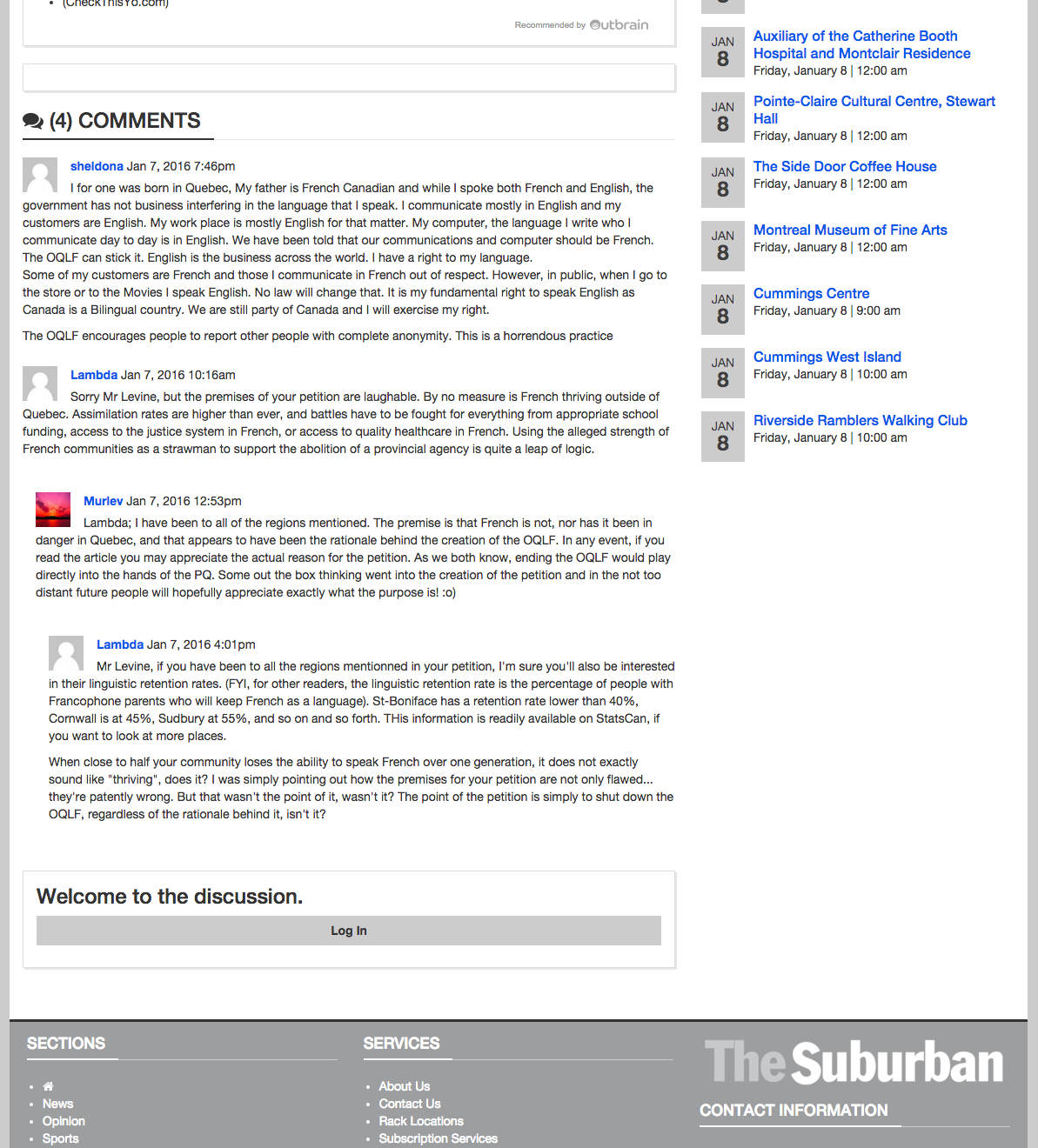
« Mr Levine, if you have been to all the regions mentionned in your petition, I’m sure you’ll also be interested in their linguistic retention rates. (FYI, for other readers, the linguistic retention rate is the percentage of people with Francophone parents who will keep French as a language). St-Boniface has a retention rate lower than 40%, Cornwall is at 45%, Sudbury at 55%, and so on and so forth. This information is readily available on StatsCan, if you want to look at more places.
When close to half your community loses the ability to speak French over one generation, it does not exactly sound like « thriving », does it? I was simply pointing out how the premises for your petition are not only flawed… they’re patently wrong. But that wasn’t the point of it, wasn’t it? The point of the petition is simply to shut down the OQLF, regardless of the rationale behind it, isn’t it? »
***
VERITY STEVENSON, Toronto Star, Jan 07, 2016
Tamil and Tagalog speakers can get instructions in their mother tongue in Toronto, but this year, not francophones.
Toronto’s waste collection calendar reduced, but did not reuse or recycle its French. The 2016 calendar, distributed to every household in the city of Toronto, is translated into seven languages, including English, but omitted Canada’s other official tongue.
“The City of Toronto regrets the error,” Nicole Dufort, a city spokesperson, said in an email to the Star.
The document indicates when, where and how to dispose of various kinds of waste. Each month’s page contains tips and information on waste management, from hazardous and electronic items to bin replacement. At the bottom of each page are six summaries in different languages.
In 2015, the calendar featured French, Chinese, Italian, Polish, Portuguese and Spanish, according to Gilles Marchildon, a member of the city’s French Language Advisory Committee. This year, French and Polish appear to have been replaced by Tamil and Tagalog.
“This was a mistake,” Dufort conceded in the email, of the lack of French. “It began with the best of intentions to reach a wider audience with our messages. At the same time, there was confusion about the City’s translation policy.”
Dufort explained that, in translating the calendar, the city’s advertising policy — which requires translation into Toronto’s top six spoken languages — was followed. But its translation policy stipulates that whenever the city translates a document into another language, it must also be translated into French. That policy wasn’t followed.
French was added to the online version of the calendar and will be reinstated in 2017’s edition.
“It’s mind-boggling; I don’t understand how that could be forgotten,” Lianne Doucet, a French-speaking Leslieville resident said of the blunder. “It’s kind of funny.”
Thierry Lasserre, another Franco-Ontarian and the executive director of Alliance Française, a French school and cultural centre in the city, didn’t find the matter amusing.
“Is it really comical?” Lasserre said. “It sounds like they forgot that Canada — from a federal perspective — is a bilingual country.”
According to the city of Toronto’s website, only 1 per cent of the city’s population speaks French at home.
The Franco-Ontarian community may be small but it’s “intensely proud,” said Doucet, who is advocating for the establishment of a new public French-speaking high school in the city’s east end. She recalled how the minority language had historically been taught clandestinely because of past rules against it.
On second thought, she said could picture how French could be forgotten in the city hall office that dealt with the calendar: “People who don’t speak French, we’re kind of invisible to them.”
Aside from its own policies, Toronto didn’t break any provincial laws in the mistake — it’s up to municipalities to decide whether to include French in its promotions. “But they certainly didn’t endear themselves,” to francophiles with it, Doucet said.
The French Language Advisory Committee, Marchildon said, addressed the mistake in one of its December meetings. It was told it was a mistake, but not how it happened, which he said “perplexed” him.
“It’s always a challenge to remind the city of the importance and belonging that French has,” Marchildon said. “It’s not like it’s the second most spoken language (as it is elsewhere in the province). It’s a question of visibility.”
***
Mise à jour le lundi 22 février 2016
Plus de cent ans après l’adoption du Règlement 17, la première ministre de l’Ontario, Kathleen Wynne, a présenté des excuses officielles, aujourd’hui, au sujet de cette législation qui a banni l’enseignement du français des écoles ontariennes de 1912 à 1927.
Le gouvernement conservateur de l’époque craignait une invasion francophone.
Ce n’est qu’après des années de lutte des francophones de l’Ontario et du Québec et de certains anglophones que ce que les Franco-Ontariens ont surnommé le « règlement infâme » a été annulé.
« Aujourd’hui, au nom du gouvernement de l’Ontario, je présente des excuses à tous les Franco-Ontariens. » — Kathleen Wynne, première ministre
La première ministre Wynne a exclu toute compensation financière pour la communauté francophone.
« Je ne pense pas que ça va effacer ce qui a été fait, a renchéri la ministre déléguée aux Affaires francophones, Madeleine Meilleur. Mais je pense que ça va soulager la peine des Franco-Ontariens, qui ont été marqués au fer chaud. » Mme Meilleur, une Franco-Ontarienne d’adoption, raconte que les grands-parents de plusieurs de ses amis ont « perdu leur langue » à cause du Règlement 17.
Le député conservateur de l’Ontario Steve Clark a présenté des excuses au nom de son parti, qui était au pouvoir lors de la mise en place du Règlement 17. « Il y a eu une erreur dans le passé, a-t-il dit, et il est important de reconnaître cette erreur. »
La chef néo-démocrate Andrea Horwath a affirmé, elle, qu’il s’agissait d’une « époque très sombre » dans l’histoire ontarienne. Elle s’est excusée elle aussi de la situation.
Pour sa part, l’Assemblée de la francophonie de l’Ontario accueille avec « enthousiasme » les excuses du gouvernement. « Ce geste va permettre de fermer la porte sur un chapitre noir de l’histoire franco-ontarienne », selon Denis Vaillancourt, président de l’organisme.
L’Ontario, qui compte aujourd’hui plus de 611 000 francophones, est la province où habite le plus grand nombre de francophones à l’extérieur du Québec. Depuis 1998, les Franco-Ontariens ont leurs propres conseils scolaires, qu’ils gèrent de façon indépendante.
***
Les relations ANGLO-FRANCO dans le cinéma québécois :
Les États-Désunis du Canada (2012) de MICHEL BARBEAU, GUYLAINE MAROIST & ÉRIC RUEL (December 8, 2015)
Reaction: A Portrait of a Society in Crisis (1973) by ROBIN SPRY (May 1, 2015)
Le journal de madame Wollock (1979) de GILLES BLAIS (January 15, 2015)
Le sort de l’Amérique (1996) de JACQUES GODBOUT (January 16, 2015)
Speak White (1980) & Le temps des bouffons (1985) de PIERRE FALARDEAU et JULIEN POULIN (January 20, 2015)
Le mouton noir (1992) & Les héritiers du mouton noir (2003) de JACQUES GODBOUT (January 22, 2015)
Le confort et l’indifférence (1981) de DENYS ARCAND (January 26, 2015)
Le chat dans le sac (1964) de GILLES GROULX (April 7, 2014, à la toute fin de l’entrevue)
Québec Soft (1985) de JACQUES GODBOUT (June 24, 2011)
Mon oncle Antoine (1971) de CLAUDE JUTRA (December 24, 2010)
Les événements d’octobre 1970 (1974) de ROBIN SPRY (October 6, 2010)
***
Québec Bashing (2015) de GENEVIÈVE BERNARD BARBEAU (December 18, 2015)
“What are Anglophones in Québec really like ?” (December 6, 2015)
L’invention d’une minorité: les Anglo-Québécois (1992) de JOSÉE LEGAULT (May 31, 2015)
Identité culturelle, sept septembre MMXII, St-Henri, Montréal p.Q. (September 7, 2012)


