Could it be magick? The occult returns to the art world

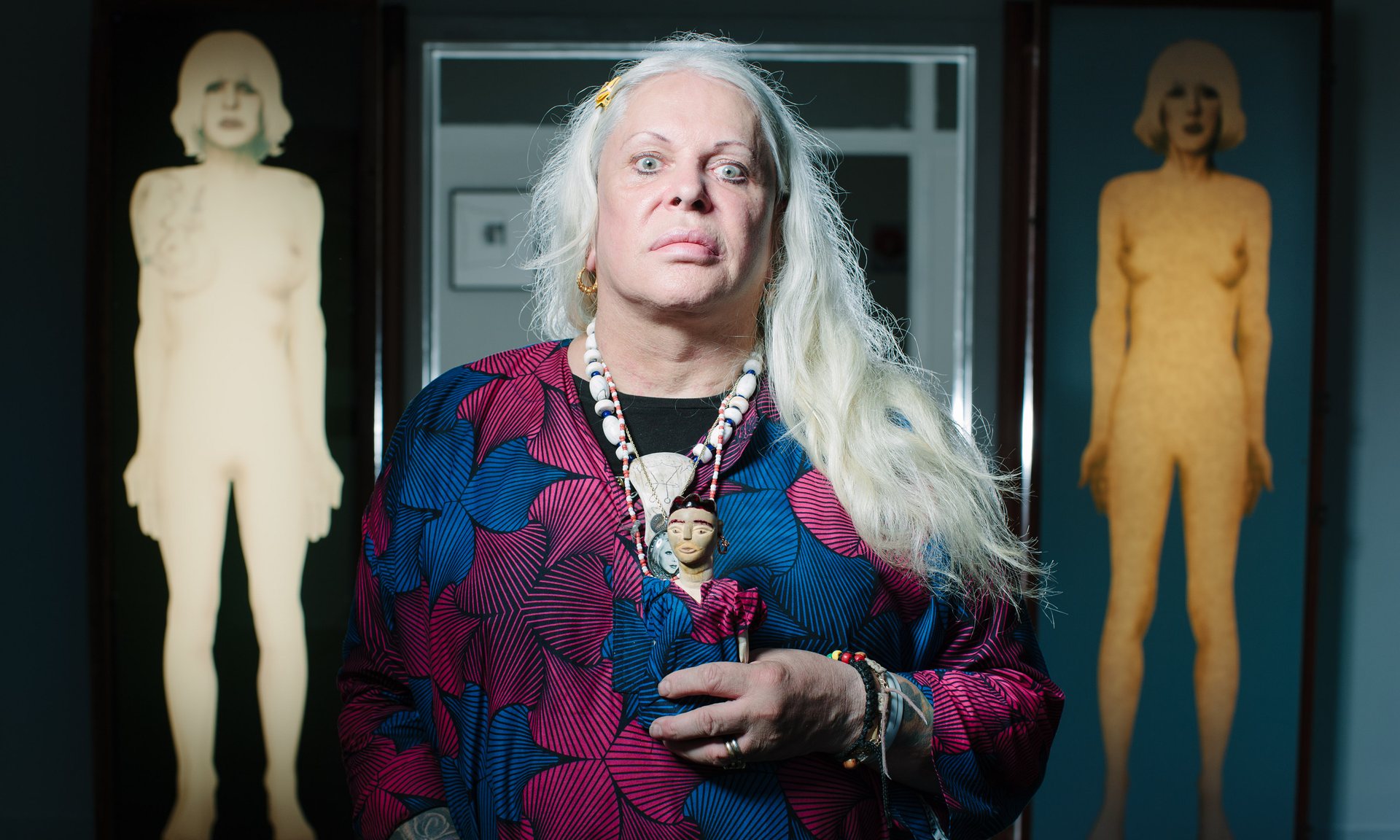
GENESIS BREYER P-ORRIDGE: a pandrogenous devotee of sex magick. Photograph: Peter Dibdin/Publicity image

GENESIS BREYER P-ORRIDGE: a pandrogenous devotee of sex magick. Photo Peter Dibdin/Publicity image


GENESIS BREYER P-ORRIDGE and TONY OURSLER have spent many years exploring paranormal phenomena through their artworks. Now, both have major exhibitions in New York – and suddenly they’re not alone in their interests.

Drugs, blood, caskets, fish and hair all feature in the arsenal of supplies enlisted for art by GENESIS BREYER P-ORRIDGE. A few more, for variety’s sake: bones, a brass hand, dominatrix shoes and the discarded skin of a pet boa constrictor.


Best known as a musical dissident with the proto-industrial band Throbbing Gristle and later Psychic TV, BREYER P-ORRIDGE has made visual art for decades as part of a ritualistic practice in which boundaries tend to blur. The first transmissions of musical noise started in the 1970s, but art has been part of the project from several years before then to the present day. Work of the more recent vintage makes up the bulk of GENESIS BREYER P-ORRIDGE: Try to Altar Everything, an exhibition on view at the Rubin Museum of Art in New York.


The Rubin show focuses on correspondences between global contemporaneity and historic cultures from areas around the Himalayas and India, and the show surveys, in an expansive fashion, BREYER P-ORRIDGE’s engagement with ideas from Hindu mythology and Nepal. Nepal is a favored haven away from the artist’s home in New York, but – as with most matters in BREYER P-ORRIDGE’s realm – worldly matters turn otherworldly fast.
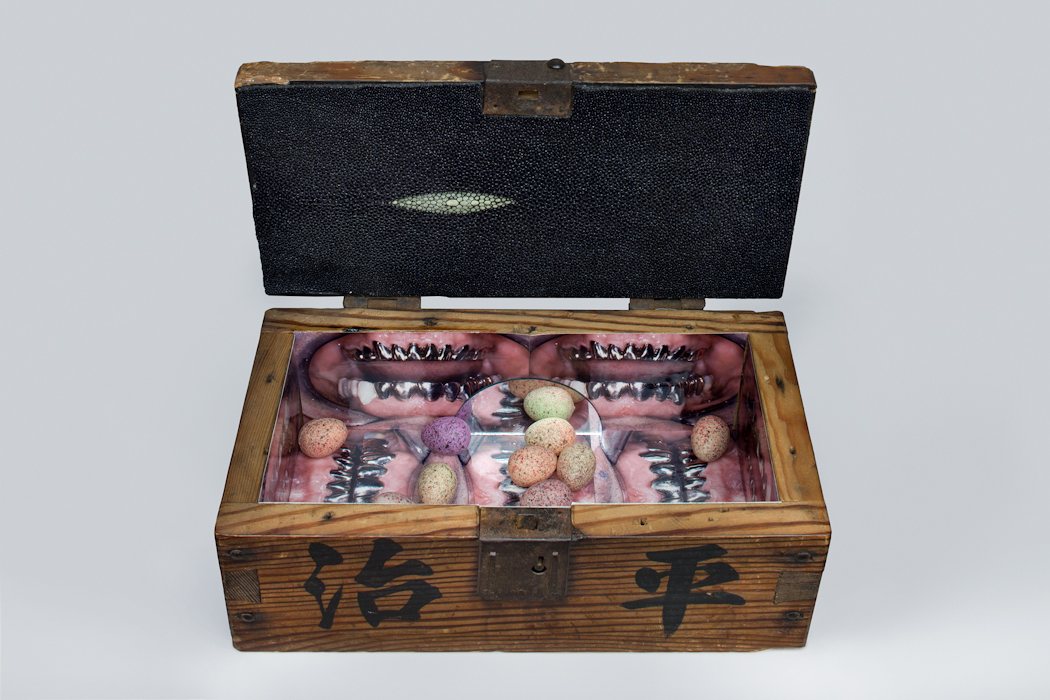

Reliquary by GENESIS BREYER P-ORRIDGE. Photo Invisible Exports

‘Reliquary’ by GENESIS BREYER P-ORRIDGE. Photo Invisible Exports


Visitors to the exhibition are greeted by two large illuminated portraits of nude bodies on the surface of caskets standing on end, one belonging to the artist and the other to h/er late partner and muse LADY JAYE BREYER P-ORRIDGE. The unorthodox pronoun “h/er” is not a mistake but the preferred way to address the genderless existence of the pandrogyne, a state of male-female fusion the two were seeking to achieve by way of surgical incursions and rituals to combine souls. The undertaking was chronicled intimately in the 2011 documentary The Ballad of Genesis and Lady Jaye, released to wide acclaim four years after LADY JAYE fell prey to cancer and died (or “left her body,” as GENESIS tells it). Now, Try to Altar Everything brings some of the couple’s collaborative artwork into the light.


Blood Bunny, made over 10 years until its completion in 2007, is a sculpture under glass of a wooden rabbit covered in blood. Hanging from its head is a ponytail made from LADY JAYE’s hair, bright blond in contrast to the dark blood all but black in its desiccated state. The source of it was needle pricks from injections of the powerful drug ketamine, which the couple took – and BREYER P-ORRIDGE reveres still – for its fabled out-of-body experiences.


“It’s such a powerful material that we don’t waste it – we use it. We’ve got little vials of blood in our refrigerator at home,” BREYER P-ORRIDGE says while staring the bunny down at the museum on a recent sunny afternoon.
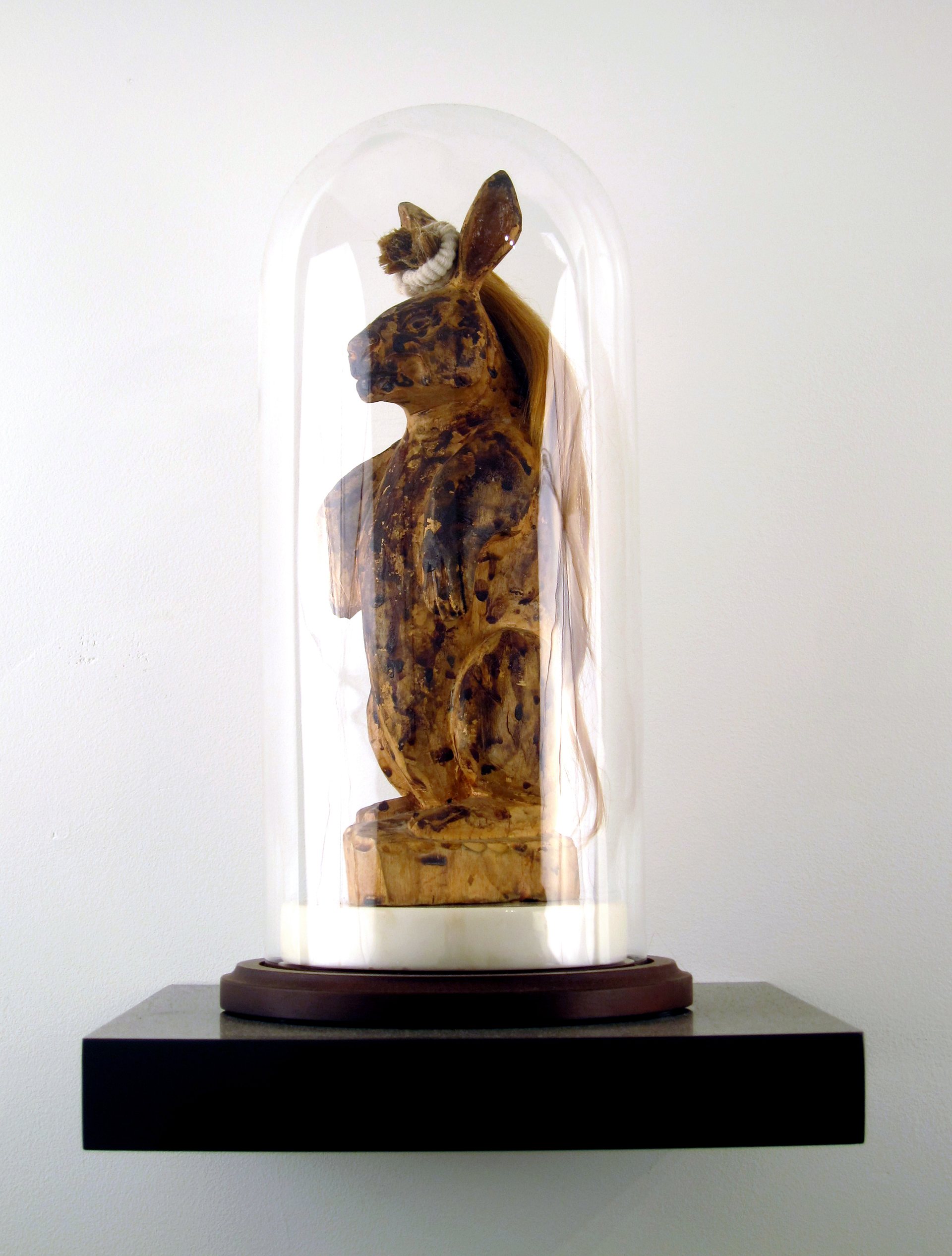

'Blood Bunny': includes blood infused with ketamine. Photo Invisible Exports

‘Blood Bunny’: includes blood infused with ketamine. Photo Invisible Exports


Nearby are a small sculptural shrine with dried fish slathered in sparkles over an abstract mandala design (Feeding the Fishes, 2010) and an odd clock remade with fossil teeth, feathers and bits of gold alluding to alchemical forces (It’s All a Matter of Time, 2016).


Works of the sort in the show serve as reliquaries or tools for use in rituals rooted in a mixture of familiar religions (Buddhism, Hinduism, voodoo) and inclinations toward the more arcane realms of black magic and the occult.


“We’ve investigated lots of avenues and that includes occulture of various types,” says BREYER P-ORRIDGE, who uses the word “we” exclusively in reference to a sort of individual and collective self. Early learning from occult figures like ALEISTER CROWLEY and mysterious magical sects like the Ordo Templi Orientis led to a lifelong devotion to ritualistic practice that has expanded and evolved.


S/he speaks highly still of “sex magic, where the orgasm is the moment when all forms of consciousness in your mind are joined, temporarily, and therefore you can pass a message through.” And other ceremonial endeavors involving age-old symbols and codes continue to be part of a method of art-making that is as much about the making as the end result.
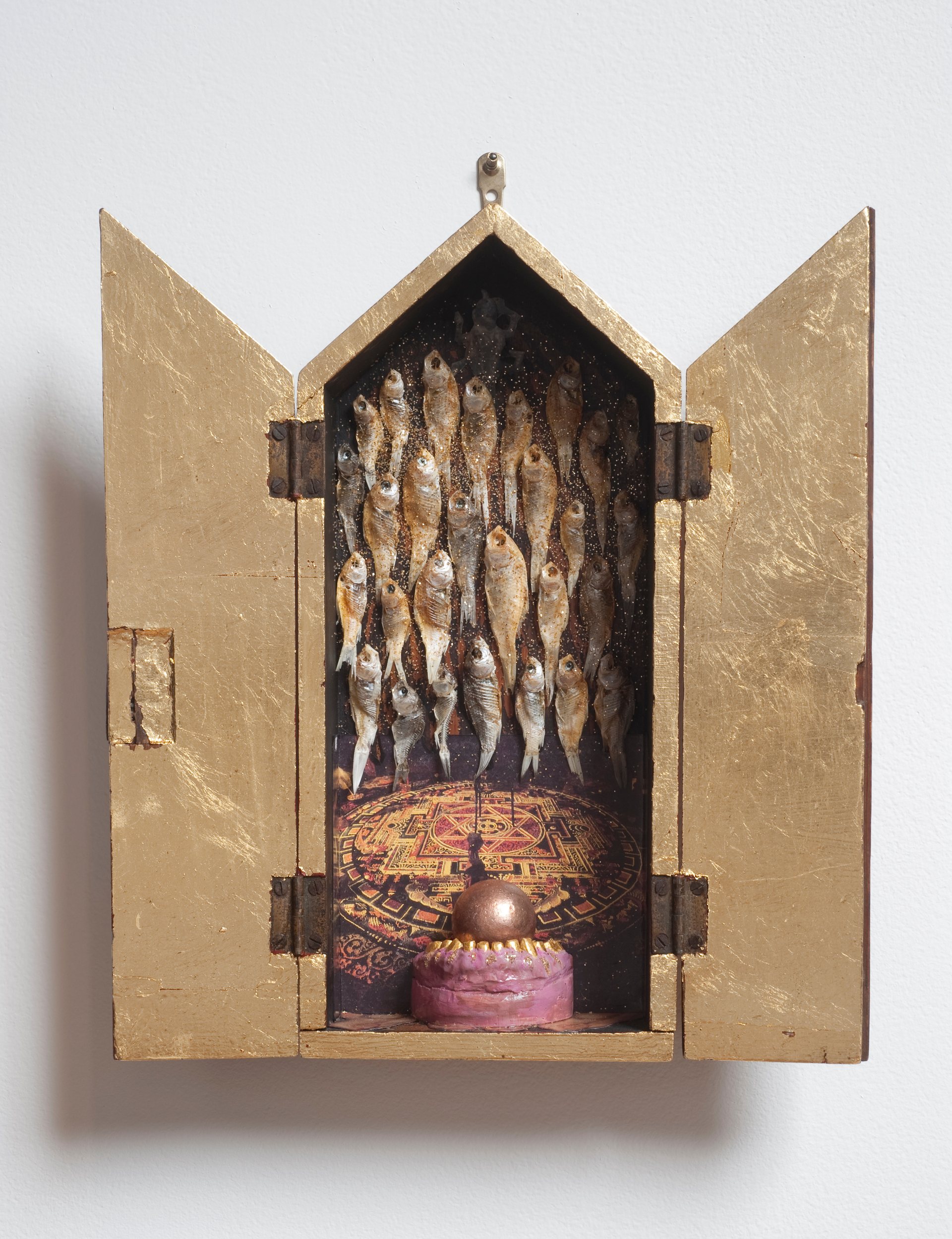

GENESIS BREYER P-ORRIDGE 'Feeding the Fishes': a small sculptural shrine. Photo Invisible Exports

GENESIS BREYER P-ORRIDGE ‘Feeding the Fishes’: a small sculptural shrine. Photo Invisible Exports


An essay in the catalog for the Rubin show refers to BREYER P-ORRIDGE’s earliest work’s dedication to “the ‘discovery of intention’, meaning it created and unearthed its message and relevance through performance, not before,” while characterizing h/er ritual-abetted communion with LADY JAYE as a “living, experimental work of art in the process”.


The exhibition, which continues through 1 August, arrives in the midst of a certain vogue for art attuned to occult practices. Last fall, a survey of demonic and deranged paintings by MARJORIE CAMERON, an associate of notorious rocket-scientist/occultist JACK PARSONS and film-maker KENNETH ANGER, showed at the gallery of prominent New York art maven JEFFREY DEITCH. A group show titled Language of the Birds: Occult and Art gathered work by the likes of BRION GYSIN, JORDAN BELSON, ANOHNI, LIONEL ZIPRIN, CAROL BOVE and many more (including BREYER P-ORRIDGE) in the 80WSE Gallery at New York University. Uptown at the American Folk Art Museum, a show titled Mystery and Benevolence: Masonic and Odd Fellows Folk Art drew visitors before closing in May.


Enough interest has been fostered and fanned out to make one wonder about the source of it all. Is it a yearning for art made for purposes other than mere aesthetic enterprise? A desired deferral to forces other than those proffered by markets and asset-class finance deals? A curiosity about creations devised with a mind for matters at play outside internal dialogues within just the art world itself?


TONY OURSLER, who has a new exhibition with paranormal proclivities on view at the Museum of Modern Art, says he can see the appeal of looking beyond the artistic pursuit for other forms of reason and rationale.


“A lot of people are trying to move into more social practices to find some relevance. It’s probably refreshing for people to see a certain kind of agency that can be offered in other practices,” the artist says.


OURSLER’s show is more playful and inclined toward levity and debunking than BREYER P-ORRIDGE’s. It includes parts of an immense archival collection related to stage magic and historical matters such as spirit photography and telekinetic mediums popular in the early 20th century, when notions of ghosts and transmissions from other worlds were very much part of the cultural conversation. The archive and a fanciful feature-length film, Imponderable, chart a peculiar history involving OURSLER’s own grandfather CHARLES FULTON OURSLER and his real-life dealings with characters including SIR ARTHUR CONAN DOYLE, HOUDINI and various spirit-world fixtures who turned out to be hucksters and frauds.


About the magnetism of such a subject, OURSLER speaks of an “unending interest in magical thinking and how it’s generated through media and various social means that led me back to these world views.”

He insists, too, that they are not as anachronistic as many might suspect. “Everyone walks around with a matrix of beliefs through which they view the world,” OURSLER says. “Statistically, if you look at America, it turns out roughly 60% of the population believes in ESP. One in three people do not believe in evolution. Forty percent of the public believes in UFOs. The rationalism we assume to be there might not, in fact, be there.”


BREYER P-ORRIDGE attributes rising interest in the occult to certain fleeting motivations. “Some of it is pure fashion, always,” s/he says. But the role of ritual and faith in its own ends can be a guide. After growing weary of the hierarchies and conscriptions of ceremonial magic as practiced early on (see: robes, chants, gestures with strict limitations and rules), “We thought: Do you need all the fancy theatrics or is there something at the core that makes things happen? Our experience tells us it’s just one or two things at the core. One of those is being able to reprogram one’s deep consciousness through repetition in ritual.”


When a working sense of ritual conjoins with the process of making art, the result might be differently invested. “When we walk around to galleries, we’re nearly always disappointed,” BREYER P-ORRIDGE says of art s/he sees around town. “Most of it is not about anything. It’s decorative at best and looks nice in penthouses. And now it’s gotten more corrupted because it’s like the stock market – people going around to advise people what to buy as an investment. You can’t trust the art world.”


To be trusted instead: “That strange reverberation that tells me what’s fascinating.”


Andy Battaglia
The Guardian


***


First Transmission (1982) by PSYCHIC TV (January 7, 2015)
Bight of the Twin (2014) by HAZEL HILL McCARTHY III (July 1, 2014)
Les yeux de GENESIS BREYER P-ORRIDGE présentés à La Centrale (October 1, 2012)
La bible psychique de GENESIS BREYER P-ORRIDGE (December 7, 2010)
‘Thee Psychick Bible’ A New Testameant By GENESIS BREYER P-ORRIDGE (October 27, 2009)

‘Famous Deaths’ présentée dans le cadre de l’exposition SENSORY STORIES au Centre Phi


L’installation Famous Deaths recrée par l’olfaction et l’audition les derniers instants de vie de deux légendes: Whitney Houston et John F. Kennedy.


L’œuvre, créée par Sense of Smell, fait partie de l’exposition Sensory Stories: donner corps au récit à l’ère numérique, véritable voyage initiatique à travers les émotions et les sensations encourageant l’expérimentation de réalités autrement inaccessibles.


‘Famous Deaths’ présentée dans le cadre de l’exposition SENSORY STORIES au Centre Phi

© Centre Phi


Sensory Stories: donner corps au récit à l’ère numérique
Une exposition interactive à vivre au Centre Phi (Montréal p.Q.) : 13 œuvres qui transportent le visiteur dans un voyage sensoriel dont il est le héros.


Présentée du 14 juin au 21 août 2016


***


À la vie, à la mort de WALTER SCHELS & BEATE LAKOTTA à la Basilique Notre-Dame (July 8, 2012)
The Dead (2010) de JACK BURMAN (September 13, 2011)
At the Hour of Our Death by photographer SARAH SUDHOFF (October 29, 2010)

GRIMPOSIUM explore le Metal extrême norvégien


Le festival GRIMPOSIUM explore toutes les facettes de la musique metal extrême (…). L’événement comprend des spectacles, mais aussi des conférences et des films. L’édition 2016 s’intéresse à la culture du black metal norvégien. On a rencontré l’organisateur pour parler des similitudes entres les scènes metal québécoise et norvégienne.


BlekkMetal
Directed by David Hall
Presented by Grimposium and Uneasy Sleeper.


BlekkMetal film Canadian premiere, Q&A with festival organizers and filmmakers; at VA114 cinema, Concordia University (Montréal p.Q.) – FREE on 3rd July. Facebook event here.


BLEKKMETAL - screening


***


GRIMPOSIUM: The Resurrection (June 18, 2015)
GRIMPOSIUM: Trve Kvlt Arts, Films, Sounds and Texts in Extreme Metal (March 22, 2014)


***


Black Metal (1998) de MARILYN WATELET (July 13, 2015)
How Much Black Metal Can You Take? (April 13, 2014)
One Man Metal (2012) presented by Noisey (December 20, 2012)
Xasthur par BRYAN SHEFFIELD, Self-Titled numéro 8 (June 23, 2011)
Black Metal Satanica (2008) by MATS LUNDBERG (June 13, 2011)
‘Black Metal’ (2005) photographs by STACY KRANITZ (June 4, 2011)
Svart Metall’ (2009) par GRANT WILLING (June 2, 2011)
Until the Light Takes Us (2009) by AARON AITES & AUDREY EWELL (June 1, 2011)
Norsk Black Metal (Norwegian Black Metal) (December 4, 2010)
Det Svarte Alvor (1994) A Black Metal Documentary (December 2, 2010)

Is Satan Still a Big Deal in 2016?

SATANIC PANIC: POP-CULTURAL PARANOIA IN THE 1980s

In a complete surprise to its authors, Satanic Panic: Pop-Cultural Paranoia in the 1980s, has sold out its first run. The second release by Spectacular Optical—a Canadian small-press publisher named after the ominous store-front from David Cronenberg’s Videodrome—explores the hysteria that percolated in the 1980s over devils hiding behind every door, be it in film, TV, music, and even children’s toys! Satan was everywhere! No one was safe!


Luckily their UK Publisher FAB Press has just released a new printing to catch up with the unexpected demand.


We met up with editors Kier-La Janisse and Paul Corupe to talk about the book’s success, whether Satan is still relevant in 2016 and what’s on the horizon.


VICE: Were you surprised the book sold out so quickly? Or were you surprised that the book was so quickly embraced?
Kier-La Janisse: I was surprised it sold out so quickly only because I usually don’t have that kind of luck, not to mention we only sold it in pre-sales through Indiegogo, on our website, and in person at events. And hardly anyone reviewed it—but the good thing about that is that it means the FAB Press edition can still get out there a lot more widely. But in terms of the appeal of the content, I wasn’t surprised people responded to it—people are very interested in this stuff and yet seem to have a superficial understanding of how it all played out, what influences were at work, etc. And so the book tries to show how all these different elements combined to create kind of a perfect storm.


What parts of the book still resonate in 2016?
Paul Corupe: Obviously, the popular fascination of the time has died down but most of it still resonates today since so much of it ended in questions, rather than answers. There are still heated corners of the internet who passionately debate this kind of stuff, and current scandals like the Jimmy Savile allegations seem to dredge up the past again and again. Like, if this stuff really happened, then the McMartin preschool case wasn’t so far fetched, right? Every time some kid up in court blames a heavy metal or rap song for what they did, the shadow of the panic will rise again.


Janisse: As gets mentioned in the book a few times, this kind of a panic resurfaced in the UK in the wake of the Jimmy Savile scandal and in both cases the idea of organized child abuse always somehow gets lumped in with a supernatural conspiracy in a way that undermines the charges. So as far as that significant part of the Satanic Panic that involved sexual abuse cases, those allegations and anxieties have been more visible in the news in recent years, but the pop-cultural artifacts of the 80s relating to fears about heavy metal and dungeons and dragons, those are a part of their time, and so they are of interest to people due to a very distinct aesthetic that people are nostalgic about.


If Trump wins in America would you do a book thirty years down the road about the kinds of moral panics his presidency would inspire?
Corupe: Of course. We don’t yet know whether phone apps and self-driving cars are portals to the occult, but it’s always better to be safe than sorry.


This fear of the unknown seems ludicrous today yet as a child I would have nightmares about Satan. My brother’s Iron Maiden wall hanging scared me. Did either of you have the same fears?
Janisse: I was raised Catholic so I definitely feared Satan and demons and all these things as a kid. And Catholicism is an especially fertile place for these anxieties to fester because Catholic imagery is so violent and grim. And in turn I think Catholicism totally fed my love of horror films—but my love of these films, and of dark music with gruesome theatrics—Alice Cooper was a favourite as a kid—also made me realize that it was possible to engage with these things and not be evil—so when musicians like Ozzy Osbourne were persecuted, or kids who played Dungeons and Dragons were portrayed as being under Satan’s spell, I felt it, because I knew that could be me. Luckily I was never denied access to horror films because my parents liked them too, but my mom’s anxiety about Satanism came out in other weird ways, usually involving household products we weren’t allowed to buy because of Satanic origins (i.e. anything made by Procter & Gamble).


Do you believe in Satan? Is Satan real?
Corupe: With apologies to the Louvin Brothers: No.


With Alison Lang’s essay on the Geraldo TV special and Ralph Elawani’s essay on Satanic anxiety in Quebec I sense that a large function of this book is to address the power and hypocrisy from such white male authorities as the Catholic church , no?
Corupe: That’s certainly a good interpretation of what happened, although we tried to keep our focus on the pop culture aspects of the panic. For me, the book is more about the con artists, conspiracy theorists and mentally unbalanced individuals that had this unprecedented impact on pop culture at the time. I don’t personally believe that the panic was really waged by the church and hardline religious types, but more by the supposed born-again Satanic priests who built cults of personality around claims that they committed atrocities before turning to God. It’s true that many influential religious organizations hypocritically embraced these figures and accepted their stories as authentic, but it’s not terribly surprising because they were being told what they wanted to hear—that those without God were tools of Satan.


Janisse: We just wanted to document things as objectively as possible (while still allowing individual authors their opinions) and as we were working on it, it became a much heavier thing than we anticipated, full of tragedy that was the result of hypocrisy, ignorance and those who took advantage of it. So, yes, that did end up being the overarching theme of the book.


Do films on Satan still hold up due to their primal power or are they just plain silly?
Janisse: Rosemary’s Baby, The Exorcist and The Omen have not lost their power. That’s partially the primal urge to believe these stories due to centuries of being hammered over the head with them, but it’s also indicative of expert filmmaking. A great filmmaker should be able to imbue a film with that power regardless of whether or not the audience are even familiar with Catholicism. Take a movie like The Believers or Angel Heart—I would guess a big part of their audience were not familiar with the practices of Voodoo or Santeria—but the idea of a religion you are not a part of and don’t understand is probably even freakier to most people than something that uses traditional devil imagery as depicted in the Christian bible. Anyways, the classics I mentioned are not part of the Satanic Panic era—many of the films of that era remain thoroughly enjoyable—Trick or Treat or The Gate for instance—but are definitely campy and silly.


Are we seeing a return to the occult in cinema with movies like The Witch, Kill List and the heavily Judeo-Christian The Conjuring ? Why do you think that is? Before that, there seemed to be a period where the monster was Matthew Lillard or that Michael Myers simply had a bad childhood.
Corupe: Yes, House of The Devil (2009) seemed to kick off a wave of new Satanic thrillers over the last decade. I can’t really say why we’ve seen a resurgence, but perhaps it has something to do with the increased polarity of political viewpoints in the United States, and groups like the Westboro Baptist Church gaining media attention. To many, religion can still be an all-consuming and scary thing.


Janisse: Agreed—we are in a time of religious extremism, so it makes sense that religion has become a popular poison in horror films again, and I suppose Satanism and other types of marginal occult religions are easier to demonize without having to engage directly in a political discussion.


What’s the most Satanic Canadian film and why?
Corupe: There are two French-Canadian films that fit the bill perfectly. The Possession of Virginia (1972) and The Pyx (1973) are about Satanic cults, and both end with black masses. These films were made in the wake of similar Hollywood horror, but also play into Quebec’s close relationship with the Catholic church that started to unravel in the 1970s. But The Gate (1988) is probably the best Satanic Panic-inspired film to come out of Canada, since it involves kids playing metal records backwards and opening up a portal to hell in their backyard.


Janisse: The Devil and Daniel Mouse! It’s just the greatest Canadian film, period.


Have you ever called 976-EVIL?
Corupe: No way—there’s not much scarier than a huge phone bill.


What’s your favourite, made-up, ludicrous ‘fact’ that was perpetuated in that era?
Corupe: There’s all kinds of facts that get passed around in TV specials and Christian videos of the time, from baby sacrifices to the Smurfs getting kids acclimatized to death to Satanists consulting on horror movies. But I particularly like Jack Chick’s comic book Spellbound, which says that all rock songs (including Christian rock) are essentially evil magic spells that are made by combining ancient druidic melodies with lyrics written by witches. Then, the master tape is blessed by « Satan’s top demon » at a ceremony under a full moon before it is put into the hands of impressionable teenagers. Seems plausible.


Why did Satanic Panic end?
Corupe: Nothing concrete ever came of all the accusations. The McMartin trial fizzled out, the West Memphis 3 case began and rock musicians began to actively rally behind their cause. Some of the concerns about heavy metal and D&D faded as those particular pastimes started to fade in popularity to make way for other teenage preoccupations in the ’90s. It was kind of like all the stars aligned in the 1980s for the panic to happen, but by the 1990s the case that the devil controlled popular culture started to unravel a bit. Of course, there are still people who believe this, though.


Kid Power, the first book by your company Spectacular Optical was about child empowerment in film. This book seems to be more about the scary puberty years where one would flirt with evil. What will the third book be?
Corupe: Our next book is going to cover Christmas horror in film and TV. There’s never been a comprehensive look at this phenomenon, and we hope to look at everything from Santa slashers to holiday ghost stories to the recent resurgence of Krampus.


Robert Dayton
Vice


***


Satanic Panic Hardcover Collector’s Set now available from FAB Press (May 15, 2016)
MMXV, Rapport annuel, bilan des opérations (December 31, 2015)
KIER-LA JANISSE and PAUL CORUPE launch Satanic Panic: Pop-Cultural Paranoia in the 1980s (July 3, 2015)
Alban Hefin, Midsommar, Litha, Samradh, Vestalia, Solstitium, Solstice Été MMXV (June 21, 2015)
A new anthology book on how the fear of a Satanic conspiracy spread through 1980s pop culture
(June 15, 2015)
Satanic Panic: Pop-Cultural Paranoia in the 1980s (March 31, 2015)